
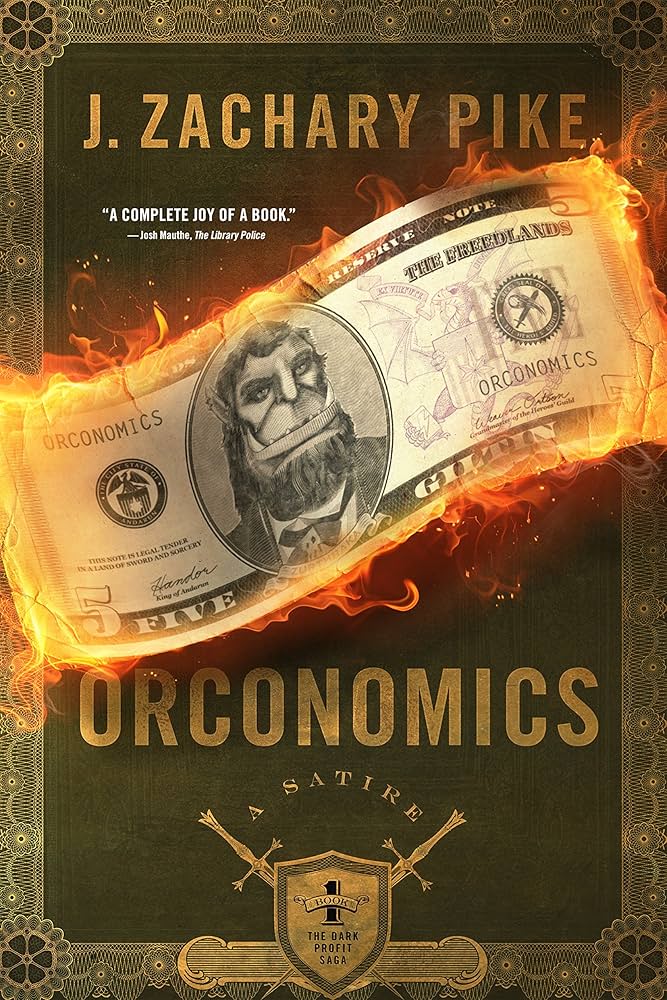
Originally posted as part of Queen’s Book Asylum’s SPFBO Champion’s League reviews.

As a comic fantasy, it’s not too hard to see where Orconomics took its inspiration, both in terms of style and in the real-world events being satirised.
The primary storyline follows the former professional hero, Gorm Ingerson, and his (mis)adventures after a rare act of kindness leads to him being drawn into a mission with a motley collection of has-beens, ne’er-do-wells and others also looking for a second chance. While that may sound like your standard fantasy quest, which it is, it also has enough self-knowledge and trope familiarity to incorporate those elements into both the plot and the world-building.
As the character we spend the most time with, Gorm is the most well-drawn of the so-called Heroes of Destiny and one that is fairly easy to identify with. Someone who wants to help and do what he can for those closest to him, a number that grows as the book progresses, but remains wary and guarded after years of scorn and self-imposed solitude. His relationship with the goblin squire Gleebek is emblematic of his growth and is one of the standout parts of the book. A few of the other members of the group are given some time to shine as well, showing off their hopes and flaws, maybe not in as much detail as Gorm, but are memorable nonetheless.
The part of the novel that doesn’t directly involve Gorm and his compatriots is arguably the part that lends the book its name and the part that has many of the strongest real-world parallels. I won’t go into them too much detail here, since I’m a strong believer that spotting these things is more fun when you do it for yourself, but I don’t think it’s any spoiler to say that several aspects of the past 50 years or so of financial history come in for some jabs.
One thing that I have seen criticised about Orconomics, aside from the fact that it’s some time before any orcs show up, is that there are several instances where the narrative essentially stops while an omniscient narrator explains some aspect of the world-building. While I can’t deny this, I think I found it less objectionable than most and, as others will point out, it does lessen the deeper into the book you get.
Similarly, I’m not sure if the humour is necessarily going to work for everyone, but for those it does, there is certainly a lot to enjoy and, with two further instalments, more still to come.
4/5 Aggressive Sellers

 thescribblings.com
Leave a comment