
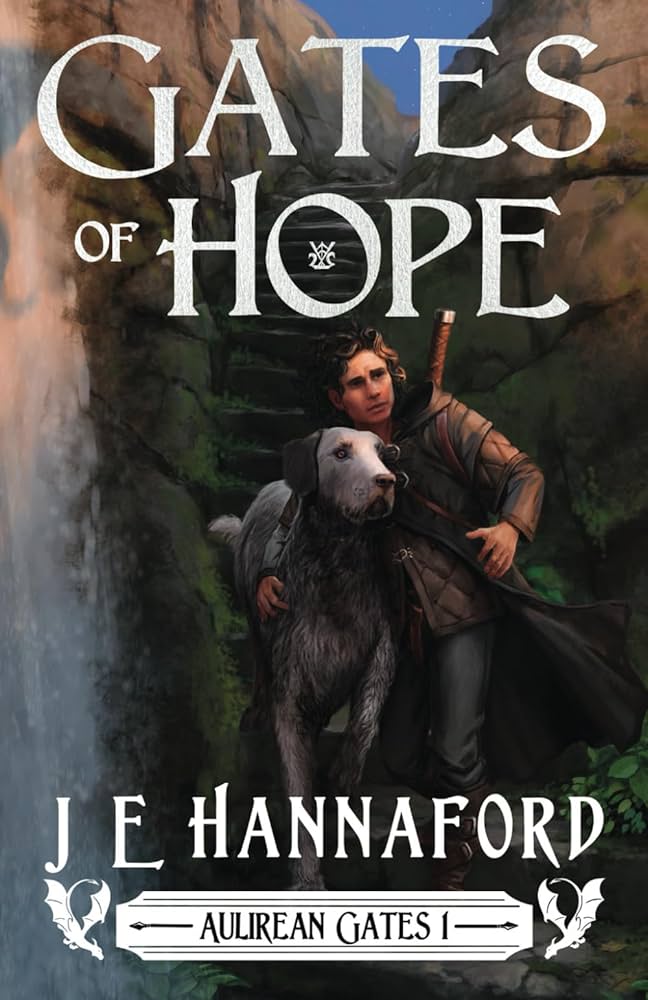
Originally posted as part of Queen’s Book Asylum’s SPFBO X reviews.
The world of Gates of Hope is perhaps one of the more fascinating ones I’ve come across in a while. At one point, the world of Lieus and its moons were linked, and travel between them was achieved by crystalline gates on each. But after conflict between humankind and the seemingly ageless alien awldrin approaches apocalyptic levels, a third party takes action. After their destruction of the gates, the bulk of humanity remains on Lieus while the awldrin are restricted to the small outer moon of Tebein. By the time of the main storyline, much of the knowledge of the gates has been lost or hidden.
We follow three protagonists in alternating chapters, Darin, Siriin and Elissa. All three are of similar age, are in the process of learning their abilities and eventually find themselves having their own quests, but that’s where the similarities end. When Darin first arrives at The Black Palace, the center of learning for magic users on Lieus, he has no ambition other than earning a decent wage that he can then send home. Having worked in his parents’ inn, he originally applies to be a guard before events push him in a different direction. While he doesn’t shirk from using magic, he does struggle with the main way in which he is taught to channel it, through song. Plus, he also gets what is probably my favourite relationship, between himself and his constant companion, Staramine.
By comparison, Siriin, as the daughter of two well regarded magic users, has known she will eventually attend The Black Palace for years. Although somewhat headstrong and prone to not thinking through her actions at first, this is tempered by the events of her journey from her isolated home to the Palace. With her primary ability of dream-walking apparent, although stifled, from a young age, she takes to the magic instruction much better than Darin.
Elissa, as a contrast, has had the hardest life of all of them. Descended from the few humans who were stranded on Tebein when the gates were destroyed, she ekes out a hard-scrabble life under the watchful eyes of the awldrin overlords. Worse, since she has the tell-tale lilac hair that signifies magical talent, she has to keep her hair constantly dyed and avoid notice or else risk not only her execution but that of everyone she knows.
The three viewpoints help to illustrate different elements of the world and showcase how much it has been thought-out. From various plants and herbs used at the Black Palace, to the placid and domesticated fala and the deadly Xotryl, it’s obvious there is a great deal of Lieus left to explore in further installments. A little less is shown of Tebein, but that’s also in keeping with Elissa’s trapped existence and it’s not until she is encouraged to leave those confines, that we begin to see more.
While it does take time for the story to progress, close to halfway before the protagonists start to have their own agency, I never felt that it dragged and patience is rewarded with plenty to enjoy.
4 out of 5 moonhounds

 thescribblings.com
Leave a comment